

WW1 The Western Front with Ronan McGreevy
4 Days / 3 Nights Per Person
Available Dates
Why Book with us?
- We are Irish owned & operated with 24+ years of group travel experience
- All of our team are experienced and have a professional approach
- We operate a 24-hour emergency service
- We regularly carry out inspection trips to the destinations we send our groups to, ensuring every hotel, excursion and partner meets our high standards
- Every itinerary can be designed around your group’s preferences, pace and budget
- Trusted coach companies and guides
- GTI Travel is proud to be Irish-owned and bonded, operating under a licence issued by the Irish Aviation Authority (IAA No. TA0533). This licence confirms that GTI Travel meets all regulatory requirements set out by the IAA, ensuring your money and travel arrangements are fully protected for complete peace of mind (See License Here)
Minimum Deposit of 250 Required
Explore The Irish Story of WWI - Led By Award-Winning Irish Times Journalist Ronan Mcgreevy
This guided WW1 Western Front tour from Ireland brings to life the story of thousands of Irish soldiers who served on the Western Front. With historian Ronan McGreevy, you’ll visit the very battlefields, cemeteries and memorials where the 16th (Irish) and 36th (Ulster) Divisions fought, often side by side. It’s a rare chance to walk in their footsteps and gain a deeper understanding of Ireland’s role in the War.
This tour is a meaningful journey of remembrance and reflection. Whether you have a family link, an interest in Irish history or a long-held desire to visit these sites, this experience offers a real connection. From the Somme to Tyne Cot Cemetery, each stop reveals the names, faces and stories of Irish soldiers whose sacrifices still resonate today.
You’ll travel with a like-minded Irish group, guided by someone who has spent years researching and telling this story. Visits to the Ring of Remembrance, the Loos Memorial and the preserved trenches of the Somme bring history into focus, adding powerful context and insight to the names, places and events you’ll encounter throughout the journey.
Best of all, GTI Travel arranges flights, hotels, transfers and guiding, so you can focus on the experience. Just arrive, take it in and return home with a deeper sense of pride, connection and understanding.
Departures from:
Our Sample Itinerary
Day 1: Arrival, Island of Ireland Peace Park, Messines Ridge & Pool of Peace & Menin Gate
Once in Brussels, check into your hotel. You will then travel to Messines to pay a sobering visit to the Island of Ireland Peace Park, a symbol of reconciliation inaugurated in 1998 following the Good Friday Agreement. View the Battle of Messines Ridge and the Pool of Peace. Visit the Wytschaete Military Cemetery in Wijtschate, Belgium to see the memorial to the 16th (Irish) Division.
Visit the two neighboring road markers to be reminded of how the 36th (Ulster) and 16th (Irish) Divisions cooperated throughout the conflict. Visit the new Willie Redmond and John Meeke memorial that is next to Wytschaete Cemetery.
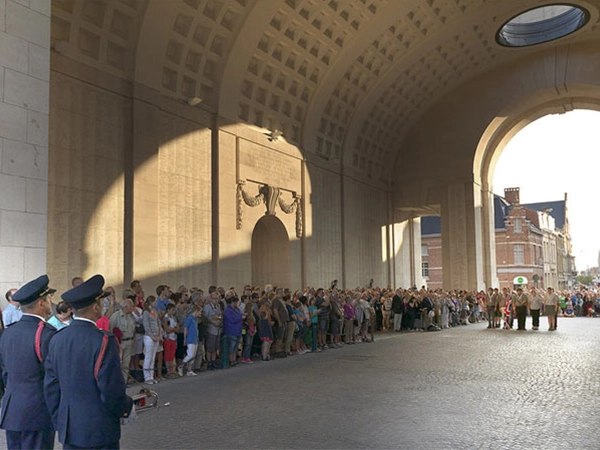
This evening, experience the moving Last Post Ceremony at the Menin Gate Memorial in Ypres. One of the most visited memorials on the Western Front, it commemorates 54,588 missing soldiers who died in the Ypres Salient. Every evening at 8pm, traffic stops and silence falls as the poignant “Last Post” is sounded in their honour, a timeless act of remembrance that has continued since 1928.
Day 2: Notre-Dame-De-International Lorette’s WWI Memorial
Today you will go to Notre-Dame-De-International Lorette’s WWI Memorial, known as the Ring of Remembrance. Check out the names of the 576,000 troops from all lands who lost their lives in northern France during the conflict. Visit the adjacent French national memorial to the 1.4 million country’s fallen as well.
From Herlies, travel to Rue Du Bois. Visit the Le Touret Memorial to see the memorialised names of the 127 members of the Royal Irish Regiment whose remains were never discovered. Visit the Portuguese and Indian war memorials before going to the location of the Last General Absolution of the Munsters at Rue du Bois. Visit the monument to the Irish fallen at the Battle of Le Pilly.
Visit Lieutenant John Kipling’s tomb and see how his passing influenced his father to pen a book on the Irish Guards’ history. visit to the London Irish Rifles’ New Memorial and The Loos Memorial to the Missing which has the names of thousands of Irish soldiers who lost their lives in that terrible fight.
Day 3: The Somme Battlefields, Tyneside Irish Memorial & Ulster Tower
On this day you travel to the Somme, Visit the Tyneside Irish Memorial at La Boisselle. Visit the Loughnagar Crater, which was destroyed on July 1, 1916, in the morning. Visit the Ulster Tower, a monument honouring the 36th Ulster Division’s soldiers. View actual frontline trenches from the Battle of the Somme at the Newfoundland Memorial. Additionally, check out the Thiepval Memorial to the Missing. Keep going to the 16th (Irish) Division memorial in Guillemont, which commemorates some of the most brutal combat throughout the whole Somme campaign.
Also visit Ginchy & Guillemont Road Cemetery and see the grave of Major Raymond Asquith, the son of the British Prime Minister Herbert Asquit. Also pay visit Herbert Lemass’s tomb; The cousin of former Taoiseach Sean Lemass.
Day 4: In Flanders Field Museum, Poelcappelle Cemetery, Grave of John Condon, Ledwidge Memorial, New Irish Memorial, Tyne Cot & Departure
Free time in the morning to visit In Flanders Field Museum or do some shopping. Afterward, meet your guide and head to Poelcappelle Cemetery and visit the grave of John Condon and learn of the real story of the teenager from Waterford who the Commonwealth War Graves Commission claim is the youngest British soldier to die in the First World War. Visit to the Ledwidge Memorial and see the memorial to the poet and nationalist Francis Ledwidge on the exact spot where he fell.
Visit to the New Irish Memorial, the monument commemorates the last time the 16th (Irish) and 36th (Ulster) Divisions fought side by side during the Battle of Passchendaele, when both divisions were utterly destroyed. Visit Tyne Cot Cemetery next, which is the world’s largest cemetery for Commonwealth war burials.
Afterwards travel to Brussels Airport and depart for Dublin Airport.
Official Memorial and Burial Records
The following official memorial authorities provide searchable records of soldiers who died during the First World War. These resources may be helpful for those researching relatives commemorated on the Western Front, including Irish soldiers.
All figures and records referenced are published by the respective memorial authorities.
Commonwealth War Graves Commission (CWGC)
The Commonwealth War Graves Commission is the intergovernmental authority responsible for recording and maintaining Commonwealth war graves and memorials worldwide. According to the CWGC, its database allows searches by name, regiment and place of commemoration across all official Commonwealth cemeteries and memorials.
Menin Gate Memorial to the Missing (CWGC)
According to the Commonwealth War Graves Commission, the Menin Gate Memorial in Ypres commemorates 54,588 soldiers who died in the Ypres Salient and have no known grave. Individual names are officially recorded and searchable within the CWGC database.
Tyne Cot Cemetery (CWGC)
According to the Commonwealth War Graves Commission, Tyne Cot Cemetery is the largest Commonwealth war cemetery in the world, containing named burials and memorial panels for soldiers who died during the Third Battle of Ypres.
Poelcapelle British Cemetery (CWGC)
According to the Commonwealth War Graves Commission, Poelcapelle British Cemetery contains named Commonwealth burials from the First World War, including Irish soldiers. Individual grave records are searchable via the CWGC database.
Le Touret Memorial (CWGC)
According to the Commonwealth War Graves Commission, the Le Touret Memorial commemorates 13,485 soldiers who died in this sector of the Western Front before 25 September 1915 and who have no known grave. Individual names are recorded and searchable via the CWGC database.
Thiepval Memorial to the Missing (CWGC)
According to the Commonwealth War Graves Commission, the Thiepval Memorial commemorates 72,311 soldiers of the United Kingdom and South African forces who died in the Somme sector before 20 March 1918 and who have no known grave. Individual names are searchable via the CWGC database.
Wytschaete Military Cemetery (CWGC)
According to the Commonwealth War Graves Commission, Wytschaete Military Cemetery contains named Commonwealth burials from the First World War. Individual grave records are searchable through the CWGC database.
Loos Memorial to the Missing (CWGC)
According to the Commonwealth War Graves Commission, the Loos Memorial commemorates 20,633 officers and men who died in the Loos sector from September 1915 to the end of the war and who have no known grave. Individual names are searchable via the CWGC database.
Guillemont Road Cemetery (CWGC)
According to the Commonwealth War Graves Commission, Guillemont Road Cemetery contains Commonwealth burials and commemorations from the First World War, largely dating from the Battle of the Somme in 1916. The cemetery includes burials of soldiers from several divisions, including the 16th (Irish) Division. Individual grave records and commemorations are officially recorded and searchable through the CWGC database.
Irish Research and Genealogy Resources
Ireland’s Great War Dead
Ireland’s Great War Dead is a publicly supported Irish research project developed in partnership with local government library services. The archive brings together county level and family information relating to Irish servicemen who died during the First World War.
The project is based on more than twenty years of research and draws on contemporary newspapers, official memorial records and historical publications. It is widely used by historians and genealogists to trace Irish connections, family background and local remembrance linked to the war.
Why this resource is helpful
A common question on First World War battlefield tours is why some Irish servicemen do not appear on major memorials such as the Menin Gate or Thiepval. Ireland’s Great War Dead helps explain this through its outline of the CWGC acceptance process, showing how commemoration decisions are made and why some cases remain under review or were not accepted due to evidence requirements. This provides valuable historical clarity and context for families researching Irish relatives before or after their visit.
In order for a candidate to be accepted for CWGC commemoration and War Grave status, they have to meet certain criteria. They must have died whilst in service with a Commonwealth military or died post-discharge of a cause proven to be due to, aggravated by or commencing during service within the qualifying dates (4th August 1914 to 31st August 1921 inclusive). If one of these criteria is met, they are accepted by the adjudicating authorities.
While this archive provides important historical and genealogical context, it is not a burial register or memorial authority. The Commonwealth War Graves Commission remains the sole official authority for burial locations and memorial commemoration.
What Historical Conflicts Does The Tour Cover?
This tour explores the First World War (1914 to 1918), focusing on significant battles and events involving Irish soldiers on the Western Front in Belgium and northern France.
The key battles and events explored, in chronological order, include:
Fighting at Le Pilly (October 1914)
Part of the Battle of La Bassée in northern France, where the 2nd Battalion, Royal Irish Regiment suffered heavy losses. The itinerary includes a memorial to the Irish soldiers who fell at Le Pilly.
Battle of Aubers Ridge (May 1915)
A British offensive in northern France involving the Royal Munster Fusiliers. The itinerary includes Rue du Bois, associated with the Last General Absolution of the Munsters on 8 May 1915, the day before the battle.
Battle of Loos (September to October 1915)
A major British offensive in northern France. Visit the Loos Memorial, which commemorates more than 20,000 British soldiers with no known grave who died in the surrounding region during the First World War.
Battle of the Somme (July to November 1916)
A major battle of WWI, including the fighting of 1 July 1916 and later battles around Guillemont and Ginchy in September. Explore historic locations including the Lochnagar Crater, Ulster Tower and Somme battlefield memorials.
Battle of Messines (June 1917)
An Allied offensive in Belgium in which the 16th (Irish) and 36th (Ulster) Divisions fought alongside each other. Visit Messines Ridge and the Island of Ireland Peace Park, which commemorates soldiers from across Ireland who died during WWI.
Third Battle of Ypres, also known as Passchendaele (July to November 1917)
A major Allied offensive in Belgium involving prolonged fighting around the Ypres Salient. Visit Tyne Cot Cemetery and memorials associated with the fighting in Flanders.
The tour also includes cemeteries and memorials commemorating soldiers who served and died during the First World War.
Frequently Asked Questions About WW1 The Western Front with Ronan McGreevy
Who is this WW1 tour suitable for?
This tour is for anyone interested in learning about the First World War, particularly the experiences of Irish soldiers on the Western Front.
You don’t need to be a history expert or have a family connection to the war. The tour includes visits to historic battlefields, cemeteries and memorials in Belgium and France.
Some visits involve outdoor walking and standing. Please contact us before booking if you have questions about accessibility or mobility requirements.
How do GTI Travel’s Battlefield Tours work?
GTI Travel organises scheduled Battlefield & History Tours that you can join on your own, as a couple, with family or with friends.
We take care of the flights, accommodation, transport and excursions included in your itinerary, so you can focus on enjoying the experience.
Travelling together? We offer discounts for groups of 4 or more people who book together. Contact our team for details of the discount available on your chosen tour.
Can GTI Travel organise a private Battlefield & History Tour for my group?
Yes! If you have a group of 15 or more people, GTI Travel can organise a private Battlefield & History Tour tailored to your group.
Whether you’re a historical society, club, association or group of friends, we take care of organising your tour, including the travel arrangements and itinerary.
Simply tell us where you’d like to go and your preferred dates, and our team can create a tour around your group’s interests and budget.
Contact GTI Travel to discuss your plans and request a quote. All arrangements are subject to availability and confirmation.
Can GTI Travel help me find or visit a relative’s war grave?
Yes! If you have a relative who served in the First World War and would like to learn more about them or visit their grave or memorial, please let us know.
Our team can help research available historical and war grave records and advise whether a visit could be included in your tour.
We recommend contacting us before booking so we can look into the details. Please note that not every soldier has a known grave, and any visit will depend on the location, available information and tour itinerary. Research results and individual visits cannot be guaranteed.
Does the tour include a historian guide?
This tour is advertised with Irish Times journalist and historian Ronan McGreevy, who is named as the historian guide for specified excursions. If his participation is an important factor in your decision, please confirm the guiding arrangements for your selected departure before booking.
What does a guide do on our Battlefield & History Tours?
Our guides explain the history, key events and stories behind the battlefields, museums and memorials you visit, helping you better understand their significance.
No previous historical knowledge is needed.
What is included in the tour price?
We take care of the main travel arrangements, including flights, accommodation, transport and guided excursions, so you can focus on enjoying the experience.
Please check the Our Price Includes section for a full breakdown of what’s included in your chosen tour, and the Booking Remarks section for any additional costs or important booking information.
Can I join the tour if I’m travelling on my own?
Individual travellers are welcome to enquire about joining a scheduled departure. Advertised prices are generally based on two people sharing accommodation, and a single room supplement may apply. Please contact GTI Travel to discuss available accommodation arrangements before booking. Room sharing with another traveller cannot be guaranteed.
What should I know about visiting the Western Front battlefields?
The tour includes visits to historic battlefields, military cemeteries and memorials from the First World War.
Some sites involve walking or standing on uneven ground, and weather conditions can vary. We recommend wearing comfortable footwear and suitable clothing.
As many of these locations are places of remembrance, we ask visitors to treat them with respect.
If you have any questions about walking distances or accessibility, please contact GTI Travel before booking.
How do I book or enquire about this tour?
Select an available departure date on this page and follow the booking instructions. Before booking, please review the tour price, inclusions, payment arrangements, cancellation conditions and applicable Booking Terms & Conditions.
For further information, contact GTI Travel on 01 843 4734 or email info@gtitravel.ie. You can also use the enquiry option on this page.
Travel & Transport
- Return flights from Dublin to Brussels, including taxes and charges.
- 10kg checked bag per person and small bag taken on board (as per airline).
- Executive private coach transfers and airport transfers (as per itinerary).
Accommodation
- 3 nights’ accommodation at a central Ypres hotel, including breakfast.
Tour Management & Guiding
- Tour manager and professional historian tour guide (Ronan McGreevy) during excursions (as per itinerary).
Meals
- Meals included (as per itinerary).
Visits & Excursions
- A selection of activities (as per itinerary)
- Entrance fees (as per itinerary).
- Memorial Museum Passchendaele 1917.
- Last Post Ceremony at the Menin Gate Memorial.
- Rue du Bois.
- Le Touret Memorial.
- Guillemont.
- The Lochnagar Crater.
- Newfoundland Park Memorial.
- The Ulster Tower.
- The Thiepval Memorial.
- In Flanders Field Museum in Ypres (optional extra).
- Free time for sightseeing, shopping at leisure or relaxation (as per itinerary).
As your travel provided we aim to give you all of the essential information about your holiday before you agree to any contract. Information such as:
- Price based on two people sharing and includes all airport taxes and charges.
- Single room supplement €149pp. If you are travelling alone and are willing to share a twin room with another group member of the same sex, we will do our best to accommodate this request, although it cannot be guaranteed.
- A non-refundable and non-transferable deposit of €250pp is required at the time of booking.
- Balance is due 12 weeks before departure.
- Price includes one standard piece of hand luggage. Extra luggage is available to purchase prior to travel (prices may vary).
- Optional travel insurance is available (terms and conditions apply).
- City taxes may apply and are payable locally at your hotel.
- Flights, taxes, prices and itinerary are subject to change.
- Your booking is made with GTI Travel (the Organiser). You are authorising GTI Travel to act as your agent, and we will arrange for you to enter into a contract with the relevant travel service provider, including airlines, hotels, insurance companies, coach hire companies, transfer companies and destination management companies.
- You are bound by the travel provider’s terms and conditions of booking. GTI Travel acts as your agent in arranging your booking; the travel provider is the principal or agent to the principal.
- We are proud to operate under a licence issued by the Irish Aviation Authority (IAA) in accordance with the Transport (Tour Operators and Travel Agents) Act, 1982.
- GTI Travel holds a valid Travel Agent Licence No. TA0533 for the period 1st November 2025 to 31st October 2026 – click here for license
- Booking terms and conditions apply. E&OE. – click here for T&C’s
Return flight from Dublin to Brussels or Amsterdam.
Flights times for each date on this tour are to be announced.
Note: we offer selected tours departing from Cork as well as Dublin (subject to availability).
Enquire today to check current departure options from your preferred airport.
For more information, contact info@gtitravel.ie or click here to reach our team directly.